


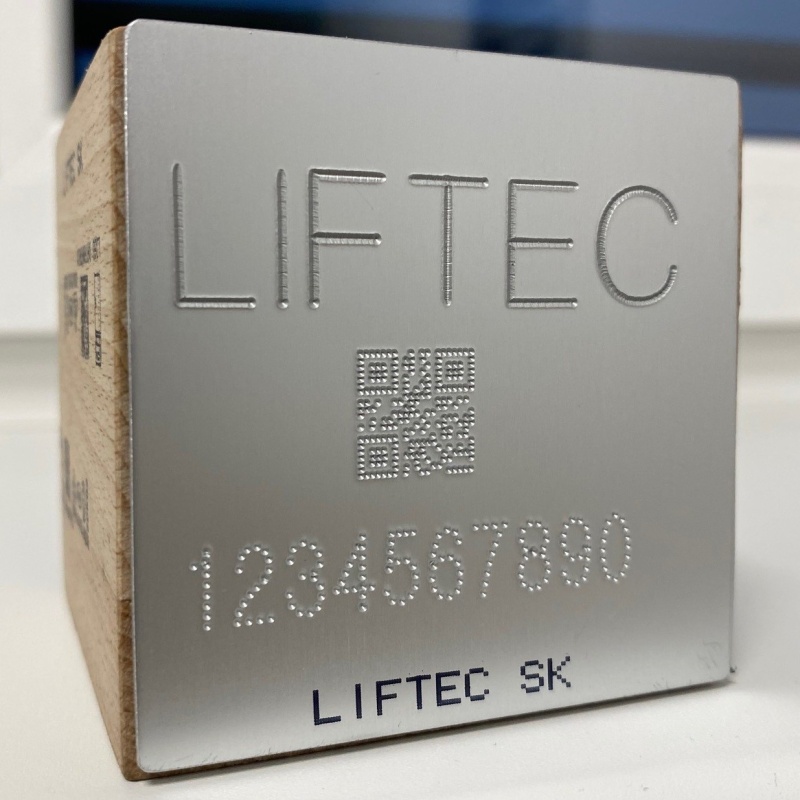
Industrial marking of products is an integral part of production today. Whether it is marking the date of manufacture, batch number, serial number or other mandatory data, the right marking technology has a direct impact on the smoothness of production, product quality and compliance with legislative requirements.
There is no universal marking technology suitable for all manufacturing companies. What is appropriate in one case may be completely unsuitable in another.
In practice, the right industrial marking technology means:
- the marking is reliable and legible throughout the product’s life,
- the technology can handle the speed and cycle of the production line,
- it is resistant to the environment of the production,
- and at the same time, it is economically sustainable – from an operation and service perspective.
Overview of the main industrial marking technologies
There are several basic industrial marking technologies on the market. Each of them has its strengths and weaknesses and is suitable for different applications.
Inkjet marking (CIJ, TIJ)
Inkjet is one of the most widely used industrial product marking technologies.
Typical applications:
- food and generally FMCG
- marking of plastic, cardboard and foil packaging
- high-speed production lines
Advantages:
- high flexibility
- possibility of marking variable data (date, batch)
- relatively low acquisition costs
- easy integration into the production line
Disadvantages:
- necessity of consumables (inks, thinners)
- regular maintenance (in the case of CIJ)
- limited durability of marking in extreme conditions
Inkjet is suitable when a fast and flexible marking is required, but operating costs must be considered.
Laser marking
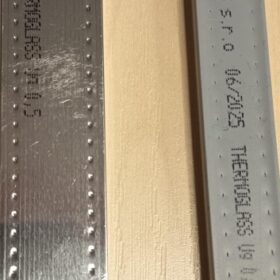
Laser marking is a contactless technology that does not use any consumables.
Typical applications:
- plastic, metal, glass and paper surfaces
- applications with an emphasis on durability and aesthetics
- operations with high demands on cleanliness
Advantages:
- very durable and legible marking
- no inks or labels
- minimal operating costs
- high accuracy
Disadvantages:
- higher initial investment
- the need to verify the suitability of the laser for a specific material
Laser marking is particularly worthwhile where long-term process stability and low operating costs are key.
Product labeling
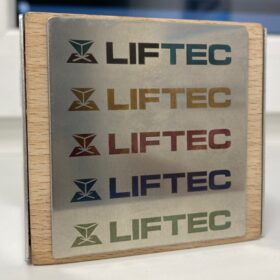
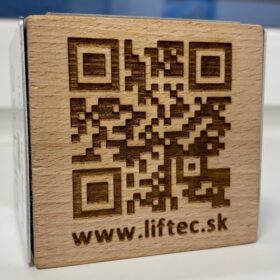
Labels are often necessary when more information needs to be provided or specific legislative requirements need to be met.
Advantages:
- color printing option
- high data variability
- easy readability
Disadvantages:
- risk of labels peeling
- problems in humid or freezing environments
- additional label costs
In practice, label application is often combined with direct printing, inkjet or laser marking.
Dot peen marking & Scribe marking
Dot peen marking is a mechanical technology that creates permanent markings directly into the material.
Typical applications:
- mechanical engineering
- automotive industry
- marking of metal parts
Advantages:
- extremely durable and permanent marking
- suitable for harsh operating conditions
Disadvantages:
- lower marking contrast
- limited use on hard materials
- less aesthetic result
OBR_5
Key criteria when choosing a marking technology
- The material of the product and the packaging have a fundamental influence on whether the marking will be legible and durable.
- The speed of the production line – the technology must handle the real production rate and have a certain reserve.
- The production environment – dust, humidity, chemicals, heat or cold have an impact not only on the marking itself, but also on the lifespan of the equipment. In the food industry, hygiene requirements also come into play.
- The data that is marked – text, character, code and the fact whether it is variable data such as batch numbers or expiration dates.
- The possibility of connecting to ERP or MES systems is also important to minimize the risk of human error.
Typical production scenarios
In practice, we often meet the following situations:
- changing packaging material for which the existing marking does not work,
- increasing production speed and increasing error rate,
- unreadable codes revealed during an audit or complaint,
- switching from manual marking to an automated solution,
- trying to unify marking across multiple operations.
In all these cases, it is crucial to assess the technology in the context of the entire production, not in isolation.
How LIFTEC SK helps with technology selection
At LIFTEC SK, we approach industrial marking as a comprehensive solution:
- we analyse the production process and environment,
- we test marking on real materials and the customer’s real environment,
- we design technology tailored to a specific application,
- we help with integration into the production line,
- we ensure long-term service and optimization of solutions.
Thanks to this, customers have the certainty that the chosen solution will work not only today, but also in the future.
If you are unsure which marking technology is right for your production, please contact us. We will be happy to walk through your operation, test the marking and design a solution that will make sense in the long term.